
Quantum computing represents one of the most revolutionary technological breakthroughs of our time, promising to solve complex problems that would take classical computers thousands of years to complete. With the global quantum computing market projected to reach $16.44 billion by 2034, growing at a robust 30.88% CAGR, understanding this transformative technology has never been more critical for businesses, researchers, and technology enthusiasts alike.
This comprehensive guide explores everything you need to know about quantum computing—from fundamental principles to practical applications, career opportunities, and implementation strategies that are shaping industries worldwide.
Table of Contents
What is Quantum Computing? A Complete Beginner’s Guide
Understanding the Quantum Computing Revolution
Quantum computing is a revolutionary field of computer science that harnesses the principles of quantum mechanics to process information in fundamentally different ways than classical computers. Unlike traditional computers that use bits (0s and 1s) for processing, quantum computers utilize quantum bits (qubits) that can exist in multiple states simultaneously through a phenomenon called superposition.
Key Quantum Computing Principles:
Superposition: Qubits can exist in a combination of both 0 and 1 states simultaneously, enabling quantum computers to process multiple possibilities simultaneously. While a classical computer with N bits can perform a maximum of N calculations simultaneously, quantum computers can perform up to 2^N calculations—an exponential increase in processing power.
Entanglement: This quantum phenomenon allows qubits to become intrinsically linked, where changing the state of one qubit instantly affects its entangled partner, regardless of the distance between them. This creates powerful computational networks that enable the solution of complex problems.
Quantum Interference: The engine of quantum computing, interference allows quantum systems to amplify correct answers while canceling out incorrect ones, leading to more efficient problem-solving.
Quantum Decoherence: The challenge quantum computers face, that quantum states collapse due to environmental factors like temperature and electromagnetic interference.
How Quantum Computing Differ from Classical Computers
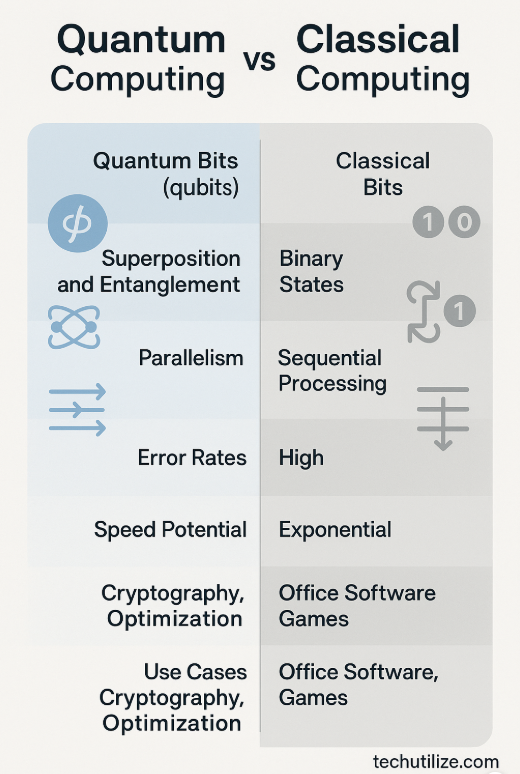
The fundamental difference lies in information processing capabilities. A classical 16-bit processor handles 16 bits sequentially, while quantum computers process information exponentially. For example, if a classical processor yields 10 calculations, a quantum processor with the same number of qubits manages 2^10, or 1,024 calculations simultaneously.
Classical Computing Characteristics:
- Sequential processing (one operation at a time)
- Binary logic (0 or 1)
- Deterministic results
- Room temperature operation
- Well-established and cost-effective
Quantum Computing Advantages:
- Parallel processing of multiple states
- Exponential computational growth
- Probability-based outcomes
- Requires extremely cold temperatures (~15mK)
- Exponentially more powerful for specific problems
The Quantum Computing Market Landscape in 2025

Market Growth and Investment Trends
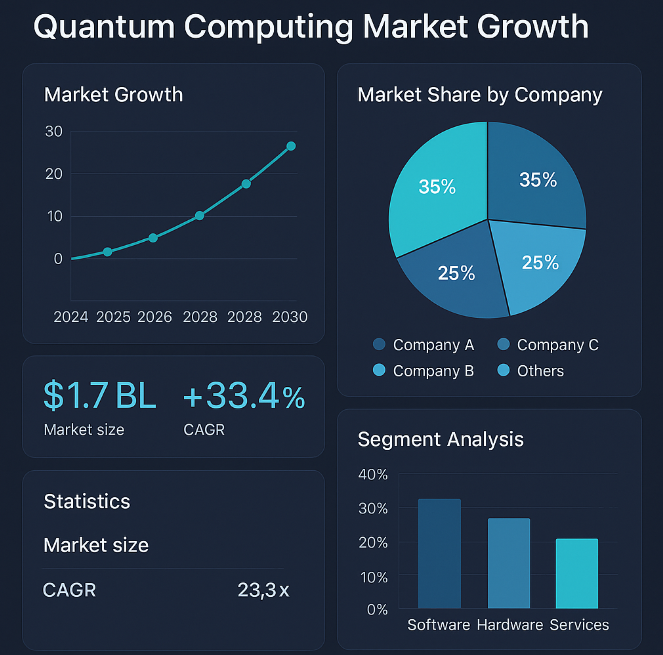
The quantum computing industry is experiencing unprecedented growth, with market valuations reaching $1.8 billion in 2025 and projected to hit $16.44 billion by 2034. This represents a compound annual growth rate (CAGR) of 30.88%, making it one of the fastest-growing technology sectors globally.
Investment Breakdown by Region:
- North America: Commands 61% market share, led by substantial U.S. government funding through the National Quantum Initiative Act
- Europe: Rapid expansion driven by applications in healthcare, chemicals, and pharmaceuticals
- Asia-Pacific: Growing presence of quantum companies and consumer adoption, with China leading significant investments
Market Segments Leading Growth:
- Services: Expected to hold the largest market share, including consulting and quantum-as-a-service offerings
- Cloud Deployment: Fastest-growing segment as organizations prefer remote quantum access
- Superconducting Qubits: Dominant revenue generator due to performance advantages
Government and Private Sector Investments
Public investment in quantum technology has reached approximately $42 billion globally, with Germany, the UK, and South Korea leading new funding initiatives. The projected talent shortage—demand for 10,000 qualified workers by 2025, with less than 5,000 available—highlights the urgent need for quantum education and training programs.
Leading Quantum Computing Companies and Technologies
Technology Giants Leading Innovation
IBM: The Quantum Computing Pioneer:
IBM leads the quantum computing space with its superconducting transmon qubit technology. Their latest Condor processor boasts 1,121 qubits, representing a significant milestone in quantum scale. IBM’s comprehensive ecosystem includes:
- Qiskit: Open-source quantum software framework
- Quantum System Two: Modular quantum computer design
- 100,000-qubit goal by 2033: Ambitious roadmap for fault-tolerant quantum systems
Google Quantum AI: Achieving Quantum Computing Supremacy
Google’s Sycamore processor achieved quantum supremacy in 2019, solving a problem in 200 seconds that would take classical supercomputers 10,000 years. Their focus areas include:
- Million-qubit goal: Targeting completion within the decade
- Cirq framework: Quantum algorithm development platform
- TensorFlow Quantum: Machine learning integration
Microsoft: Cloud-Based Quantum Computing Leadership:
Microsoft pioneered the public cloud quantum computing ecosystem through Azure, offering:
- Q# programming language: Dedicated quantum development tools
- Azure Quantum: Comprehensive cloud platform
- Majorana qubits: Revolutionary approach to quantum stability
Intel: Silicon-Based Innovation:
Leveraging semiconductor expertise, Intel develops:
- 12-qubit Tunnel Falls chip: Silicon spin qubits technology
- Cryogenic control chips: Simplified quantum system wiring
- Next-generation processors: Planned releases for 2025
Game-Changing Applications of Quantum Computing
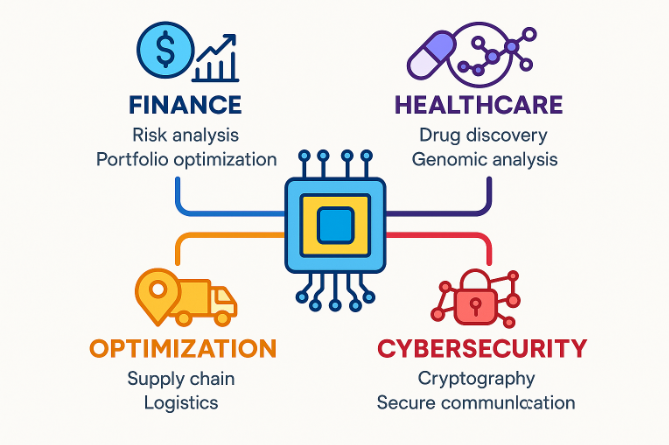
1. Financial Services Revolution
Quantum computing is transforming financial institutions through advanced modeling capabilities that can revolutionize investment strategies and risk management.
Key Applications:
- Portfolio Optimization: QAOA (Quantum Approximate Optimization Algorithm) targeting $2 trillion value by 2035
- Fraud Detection: Real-time analysis of complex transaction patterns
- Risk Assessment: Advanced credit scoring and investment risk analysis
- Quantum-Safe Cryptography: JPMorgan is advancing quantum-generated randomness for secure transactions
Expected Impact: McKinsey predicts $10-25 billion in value creation through 2-5% annual efficiency gains in manufacturing alone, with financial optimization potentially unlocking $2 trillion by 2035.
2. Healthcare and Drug Discovery
Quantum computing’s ability to simulate molecular interactions is revolutionizing pharmaceutical research and personalized medicine.
Revolutionary Applications:
- Drug Discovery: AI models identify potential compounds and predict efficacy, reducing development time from years to months
- Protein Folding: Complex molecular simulations accelerating breakthrough discoveries
- Personalized Treatment: Systems analyzing genetic data for customized treatment protocols
- Medical Image Analysis: Enhanced diagnostic accuracy with 98% precision rates
Business Impact: Quantum computers could accelerate early-stage drug discovery, potentially saving decades of research time and billions in development costs.
3. Cybersecurity and Cryptography
Quantum computing presents both opportunities and challenges for cybersecurity, fundamentally changing how we approach data protection.
Transformative Capabilities:
- Quantum Key Distribution (QKD): Ultra-secure communication channels
- Post-Quantum Cryptography: New encryption methods resistant to quantum attacks
- Real-time Security: Continuous protection for data in transit and at rest
- Advanced Threat Detection: Pattern recognition in complex security data
Critical Consideration: While quantum computers threaten current encryption methods, they also enable quantum-safe security solutions.
4. Optimization and Logistics
Quantum computing excels at solving complex optimization problems that involve multiple variables and constraints.
Strategic Implementations:
- Supply Chain Optimization: Real-time route planning and inventory management
- Traffic Flow Management: Smart city applications for urban mobility
- Resource Allocation: Workforce and manufacturing optimization
- Energy Grid Management: Renewable energy distribution and smart grid operations
5. Artificial Intelligence and Machine Learning
Quantum Machine Learning (QML) represents one of the most promising near-term applications, offering dramatic speedups for specific AI tasks.
Advanced Capabilities:
- Pattern Recognition: Enhanced fraud detection and anomaly identification
- High-dimensional Data Processing: Complex dataset analysis beyond classical capabilities
- Optimization Algorithms: Faster training of machine learning models
- Hybrid Quantum-Classical Models: Best-of-both-worlds approach for practical applications
Career Opportunities in Quantum Computing
High-Demand Quantum Jobs and Salaries
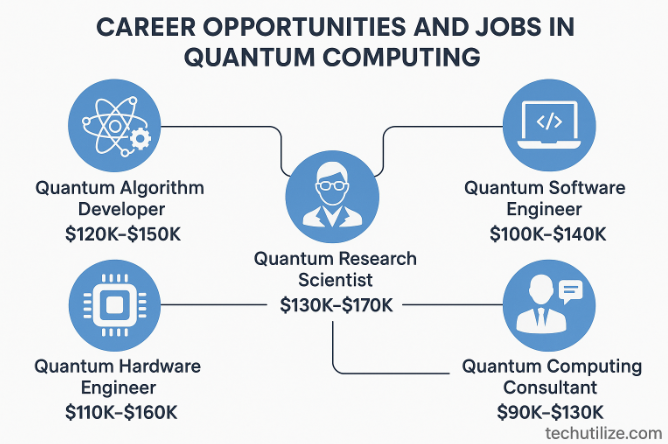
The quantum computing job market offers exceptional opportunities with competitive salaries and strong growth prospects. Here are the top career paths:
1. Quantum Machine Learning Scientist
- Average Salary: $95,565 – $140,000+ annually
- Requirements: PhD in Quantum Physics or Computer Science
- Key Skills: Quantum algorithms, machine learning, parameterized quantum circuits
2. Quantum Software Engineer
- Average Salary: $88,975 – $120,000+ annually
- Requirements: Master’s degree (PhD desirable) in quantum technology
- Key Skills: Qiskit, Q#, Python, quantum programming languages
3. Quantum Hardware Engineer
- Average Salary: $106,813 – $150,000+ annually
- Requirements: PhD in Physics or Engineering
- Key Skills: Superconducting circuits, cryogenic systems, quantum processor design
4. Quantum Algorithms Researcher
- Average Salary: $95,000 – $160,000+ annually
- Requirements: PhD in Mathematics, Physics, or Computer Science
- Key Skills: Algorithm design, quantum complexity theory, research publications
5. Senior Quantum Product Manager
- Average Salary: $140,240 – $200,000+ annually
- Requirements: Advanced degree plus business experience
- Key Skills: Technology strategy, product development, market analysis
Skills and Education Requirements
Essential Technical Skills:
- Quantum mechanics and quantum information theory
- Programming languages: Python, Q#, Qiskit, Cirq
- Linear algebra and advanced mathematics
- Classical computing fundamentals
- Statistics and probability theory
Preferred Qualifications:
- PhD in Physics, Computer Science, Mathematics, or Engineering
- Research experience in quantum technologies
- Publication history in peer-reviewed journals
- Experience with quantum simulators and cloud platforms
Implementation Strategies for Businesses
Quantum Readiness Assessment
Organizations looking to leverage quantum computing should follow a structured approach to implementation:
Phase 1: Strategic Assessment
- Identify Use Cases: Focus on optimization, simulation, or cryptography challenges
- Evaluate Quantum Advantage: Determine where quantum computing provides measurable benefits
- Resource Planning: Assess budget, timeline, and skill requirements
- Partnership Strategy: Consider collaborations with quantum computing providers
Phase 2: Pilot Implementation
- Cloud Access: Start with platforms like IBM Quantum, Amazon Braket, or Google Quantum AI
- Proof of Concept: Develop small-scale prototypes for specific business problems
- Skill Development: Train teams in quantum programming and algorithms
- Performance Benchmarking: Compare quantum solutions against classical alternatives
Phase 3: Scaling and Integration
- Hybrid Approaches: Combine quantum and classical computing for optimal results
- Production Deployment: Implement quantum solutions in business-critical applications
- Continuous Optimization: Regular performance monitoring and algorithm refinement
- Future Planning: Prepare for fault-tolerant quantum systems
Industry-Specific Implementation Roadmaps
Financial Services (2025-2030)
- Near-term: Risk modeling and portfolio optimization pilots
- Medium-term: Real-time fraud detection and trading algorithms
- Long-term: Quantum-safe cryptography implementation
Healthcare and Pharmaceuticals (2025-2035)
- Near-term: Molecular simulation for drug discovery
- Medium-term: Personalized medicine and treatment optimization
- Long-term: Comprehensive healthcare system integration
Manufacturing and Logistics (2025-2030)
- Near-term: Supply chain optimization and predictive maintenance
- Medium-term: Real-time production scheduling and quality control
- Long-term: Autonomous manufacturing systems
Future Trends and Market Predictions
Technology Roadmap for 2025-2035
Near-term Developments (2025-2027):
- Increased qubit counts reaching 1,000+ stable qubits
- Improved error correction, reducing quantum noise
- Wider cloud access democratizing quantum computing
- Hybrid quantum-classical algorithms for practical applications
Medium-term Breakthroughs (2027-2030):
- Fault-tolerant quantum computers with logical qubits
- Commercial quantum advantage in optimization and simulation
- Industry-specific quantum software platforms
- Quantum networking and distributed computing
Long-term Vision (2030-2035):
- Universal fault-tolerant quantum computers
- Quantum internet infrastructure
- Mainstream adoption across multiple industries
- Integration with artificial intelligence and IoT systems
Economic Impact Projections
Market Growth Forecasts:
- Global quantum computing market: $291.82 billion by 2035
- Quantum technology market potential: $173 billion by 2040
- Expected quantum computers worldwide: 2,000-5,000 by 2030
Industry Value Creation:
- Automotive: $2-3 billion impact by 2030
- Chemical and pharmaceutical: Early breakthrough sector targeting $2 trillion value
- Financial services: Portfolio optimization, creating massive efficiency gains
- Transportation and mobility: Revolutionary logistics and routing optimization
Overcoming Quantum Computing Challenges
Technical Hurdles and Solutions
- Quantum Error Rates
- Challenge: Current quantum computers are error-prone due to decoherence
- Solution: Advanced error correction codes and fault-tolerant designs
- Timeline: Significant improvements expected by 2027-2030
- Scalability Issues
- Challenge: Building large-scale quantum systems with thousands of qubits
- Solution: Modular quantum architectures and improved qubit technologies
- Progress: IBM’s roadmap targets 100,000 qubits by 2033
- Programming Complexity
- Challenge: Quantum programming requires specialized knowledge
- Solution: High-level programming languages and development frameworks
- Examples: IBM’s Qiskit, Google’s Cirq, Microsoft’s Q#
Business Implementation Challenges
Skills Gap and Training
- Current Status: Demand for 10,000 quantum workers by 2025, with <5,000 available
- Solutions: University partnerships, online training programs, and industry certifications
- Investment: Companies allocating 15-20% of quantum budgets to training and education
Cost and Accessibility
- Challenge: Quantum computers require expensive infrastructure and maintenance
- Solution: Cloud-based quantum computing services reducing entry barriers
- Trend: Increasing availability through Amazon Braket, IBM Quantum Network, and Google Quantum AI
Getting Started with Quantum Computing
Educational Resources and Learning Paths
For Beginners:
- Online Courses: MIT’s Introduction to Quantum Computing, IBM Qiskit Textbook
- Programming Platforms: Qiskit, Cirq, and Microsoft Q# Development Kit
- Simulation Tools: Classical quantum simulators for learning and development
For Advanced Practitioners:
- Research Programs: University quantum computing programs and research collaborations
- Industry Certification: IBM Quantum Network, Google Quantum AI Residency
- Professional Development: Quantum computing conferences and workshops
Practical Next Steps
For Individuals:
- Learn quantum mechanics fundamentals
- Practice with quantum programming frameworks
- Join quantum computing communities and forums
- Consider formal education in quantum-related fields
For Organizations:
- Conduct a quantum readiness assessment
- Identify potential use cases and applications
- Start with cloud-based quantum experiments
- Build internal quantum computing capabilities
- Establish partnerships with quantum technology providers
Conclusion: The Quantum Computing Revolution
Quantum computing has evolved from theoretical curiosity to practical reality, with 2025 marking a pivotal year for commercial applications and widespread adoption. The technology’s potential to solve previously intractable problems—from drug discovery and financial optimization to cybersecurity and artificial intelligence—represents one of the most significant technological breakthroughs in human history.
With market projections showing explosive growth to $16.44 billion by 2034 and major technology companies investing billions in quantum research, the question is not whether quantum computing will transform industries, but how quickly organizations can adapt to harness its power. The current talent shortage and technical challenges present both obstacles and opportunities for early adopters willing to invest in quantum capabilities.
As we stand at the threshold of the quantum era, businesses, researchers, and individuals who begin their quantum journey today will be best positioned to benefit from tomorrow’s quantum-powered world. The time to start exploring quantum computing is now—the future belongs to those who understand and embrace this revolutionary technology.
Ready to explore quantum computing for your organization? Start with cloud-based quantum platforms, invest in team education, and consider partnerships with quantum technology providers to begin your quantum transformation journey.