
Generative AI has emerged as the most transformative technology of our time, fundamentally reshaping how businesses operate, innovate, and compete. With the global generative AI market projected to reach $44.89 billion in 2025 and $1 trillion by 2032, understanding its business applications is crucial for staying competitive. This comprehensive guide explores the latest trends, practical applications, and implementation strategies that are driving business success across industries.
Table of Contents
The Current State of Generative AI in Business
Market Growth and Adoption Statistics
The generative AI landscape has experienced unprecedented growth in 2025. According to the latest market research, the global generative AI market has expanded at an astounding 54.7% year-over-year growth rate. The market now employs over 944,000 individuals globally, with 151,000+ new jobs added in the past year alone.
- Market Size: $44.89 billion globally in 2025
- Growth Rate: 44.20% CAGR expected through 2034
- Employment Impact: 94% of Fortune 500 companies have adopted generative AI
- Investment Volume: Over $21.8 billion in funding across 13,980+ funding rounds
- Patent Activity: 8,700+ patents with 146.99% yearly growth rate
Employee Adoption Surge
Recent data from August 2025 reveals a dramatic shift in workplace AI adoption. Employee AI usage has nearly doubled, rising from 21% to 40%, with daily users jumping from 4% to 8%. Weekly AI usage has also increased significantly from 11% to 19%, demonstrating rapid mainstream acceptance of AI tools in professional environments.
Game-Changing Business Applications of Generative AI
1. Sales and Marketing Automation
Generative AI is revolutionizing how businesses approach customer acquisition and engagement. Modern AI-powered systems can analyze customer behavior patterns, predict purchasing likelihood, and create personalized marketing campaigns at scale.
Key Applications:
- Lead Scoring and Prioritization: AI algorithms analyze customer data to assign conversion probability scores, helping sales teams focus on high-value prospects
- Personalized Email Campaigns: Automated systems create customized email sequences based on customer actions and preferences
- Content Generation: AI creates blog posts, social media content, and marketing materials tailored to specific audience segments
- Dynamic Pricing: Real-time pricing optimization based on market conditions, demand patterns, and competitor analysis
Business Impact: Companies using AI-powered sales tools report 20-40% increases in conversion rates and 30% reduction in customer acquisition costs.
2. Customer Service Enhancement
The integration of generative AI in customer service has transformed how businesses handle customer interactions, providing 24/7 support while reducing operational costs.
Advanced Capabilities:
- Intelligent Chatbots: AI assistants that understand context, emotion, and complex queries
- Automated Ticket Resolution: Systems that categorize, prioritize, and resolve common customer issues automatically
- Sentiment Analysis: Real-time emotion detection to escalate sensitive issues to human agents
- Multilingual Support: Instant translation and culturally appropriate responses across languages
Measurable Results: Businesses report a 60% reduction in response times and a 40% improvement in customer satisfaction scores.
3. Content Creation and Creative Services

Generative AI has democratized content creation, enabling businesses to produce high-quality materials at unprecedented speed and scale.
- Marketing Materials: Automated generation of advertisements, brochures, and promotional content
- Product Descriptions: AI-written copy for e-commerce platforms with SEO optimization
- Video Production: Automated video editing, scriptwriting, and synthetic video generation
- Design Assets: Logo creation, image generation, and graphic design for marketing campaigns
Productivity Gains: Content creation teams report 50-70% time savings while maintaining or improving quality standards.
4. Supply Chain Optimization
AI-driven supply chain management represents one of the most impactful applications, particularly in the post-pandemic business environment.
- Demand Forecasting: Predictive models analyzing market trends, seasonal patterns, and external factors
- Inventory Management: Automated stock level optimization to prevent overstock and stockouts
- Logistics Planning: Route optimization and delivery scheduling based on real-time data
- Risk Assessment: Early warning systems for supply chain disruptions
Financial Impact: Organizations report a 15-25% reduction in inventory costs and a 20% improvement in delivery efficiency.
5. Financial Analysis and Reporting
The finance sector has embraced generative AI for its ability to process vast amounts of data and identify patterns invisible to human analysts.
- Fraud Detection: Real-time transaction monitoring and anomaly detection
- Risk Assessment: Credit scoring and investment risk analysis
- Automated Reporting: Generation of financial reports, compliance documents, and investor communications
- Cash Flow Forecasting: Predictive models for financial planning and budgeting
ROI Metrics: Financial institutions report 35% improvement in fraud detection accuracy and 40% reduction in report preparation time.
Generative AI has emerged as the most transformative technology of our time, fundamentally reshaping how businesses operate, innovate, and compete. With the global generative AI market projected to reach $44.89 billion in 2025 and $1 trillion by 2032, understanding its business applications is crucial for staying competitive. This comprehensive guide explores the latest trends, practical applications, and implementation strategies that are driving business success across industries.
The Current State of Generative AI in Business
Market Growth and Adoption Statistics
The generative AI landscape has experienced unprecedented growth in 2025. According to the latest market research, the global generative AI market has expanded at an astounding 54.7% year-over-year growth rate. The market now employs over 944,000 individuals globally, with 151,000+ new jobs added in the past year alone.
Key market indicators include:
- Market Size: $44.89 billion globally in 2025
- Growth Rate: 44.20% CAGR expected through 2034
- Employment Impact: 94% of Fortune 500 companies have adopted generative AI
- Investment Volume: Over $21.8 billion in funding across 13,980+ funding rounds
- Patent Activity: 8,700+ patents with 146.99% yearly growth rate
Employee Adoption Surge
Recent data from August 2025 reveals a dramatic shift in workplace AI adoption. Employee AI usage has nearly doubled, rising from 21% to 40%, with daily users jumping from 4% to 8%. Weekly AI usage has also increased significantly from 11% to 19%, demonstrating rapid mainstream acceptance of AI tools in professional environments.
Game-Changing Business Applications of Generative AI
1. Sales and Marketing Automation
Generative AI is revolutionizing how businesses approach customer acquisition and engagement. Modern AI-powered systems can analyze customer behavior patterns, predict purchasing likelihood, and create personalized marketing campaigns on a scale.
Key Applications:
- Lead Scoring and Prioritization: AI algorithms analyze customer data to assign conversion probability scores, helping sales teams focus on high-value prospects
- Personalized Email Campaigns: Automated systems create customized email sequences based on customer actions and preferences
- Content Generation: AI creates blog posts, social media content, and marketing materials tailored to specific audience segments
- Dynamic Pricing: Real-time pricing optimization based on market conditions, demand patterns, and competitor analysis
Business Impact: Companies using AI-powered sales tools report 20-40% increases in conversion rates and 30% reduction in customer acquisition costs.
2. Customer Service Enhancement
The integration of generative AI in customer service has transformed how businesses handle customer interactions, providing 24/7 support while reducing operational costs.
Advanced Capabilities:
Intelligent Chatbots: AI assistants that understand context, emotion, and complex queries
Automated Ticket Resolution: Systems that categorize, prioritize, and resolve common customer issues automatically
Sentiment Analysis: Real-time emotion detection to escalate sensitive issues to human agents
Multilingual Support: Instant translation and culturally appropriate responses across languages
Measurable Results: Businesses report a 60% reduction in response times and a 40% improvement in customer satisfaction scores.
3. Content Creation and Creative Services
Generative AI has democratized content creation, enabling businesses to produce high-quality materials at unprecedented speed and scale.
Creative Applications:
Marketing Materials: Automated generation of advertisements, brochures, and promotional content
Product Descriptions: AI-written copy for e-commerce platforms with SEO optimization
Video Production: Automated video editing, scriptwriting, and even synthetic video generation
Design Assets: Logo creation, image generation, and graphic design for marketing campaigns
Productivity Gains: Content creation teams report 50-70% time savings while maintaining or improving quality standards.
4. Supply Chain Optimization
AI-driven supply chain management represents one of the most impactful applications, particularly in the post-pandemic business environment.
Strategic Implementations:
Demand Forecasting: Predictive models that analyze market trends, seasonal patterns, and external factors
Inventory Management: Automated stock level optimization to prevent overstock and stockouts
Logistics Planning: Route optimization and delivery scheduling based on real-time data
Risk Assessment: Early warning systems for supply chain disruptions
Financial Impact: Organizations report a 15-25% reduction in inventory costs and a 20% improvement in delivery efficiency.
5. Financial Analysis and Reporting
The finance sector has embraced generative AI for its ability to process vast amounts of data and identify patterns invisible to human analysts.
Financial Applications:
- Fraud Detection: Real-time transaction monitoring and anomaly detection
- Risk Assessment: Credit scoring and investment risk analysis
- Automated Reporting: Generation of financial reports, compliance documents, and investor communications
- Cash Flow Forecasting: Predictive models for financial planning and budgeting
ROI Metrics: Financial institutions report 35% improvement in fraud detection accuracy and 40% reduction in report preparation time.
Industry-Specific Implementation Examples
Healthcare Transformation
The healthcare sector has witnessed remarkable AI adoption, particularly in areas requiring pattern recognition and data analysis.
Revolutionary Applications:
- Drug Discovery: AI models that identify potential compounds and predict efficacy, reducing development time from years to months
- Personalized Treatment Plans: Systems that analyze patient history, genetic data, and current health status to create customized treatment protocols
- Medical Image Analysis: AI that assists radiologists in detecting abnormalities with 98% accuracy rates
- Electronic Health Records: Automated documentation and data extraction from unstructured medical records
Manufacturing Excellence
Manufacturing has embraced AI for predictive maintenance, quality control, and production optimization.
Operational Improvements:
- Predictive Maintenance: AI systems that analyze sensor data to predict equipment failures before they occur
- Quality Assurance: Computer vision systems that detect defects in real-time during production
- Energy Optimization: Smart systems that reduce energy consumption by 15-30% without affecting output
- Production Planning: AI-driven scheduling that optimizes resource allocation and minimizes downtime
Retail Innovation
Retail businesses are leveraging AI to create personalized shopping experiences and optimize operations.
Customer Experience Enhancements:
- Personalized Recommendations: AI systems that analyze browsing behavior, purchase history, and preferences to suggest relevant products
- Inventory Optimization: Predictive models that ensure popular items remain in stock while minimizing excess inventory
- Dynamic Pricing: Real-time price adjustments based on demand, competition, and market conditions
- Visual Search: AI-powered search that allows customers to find products using images
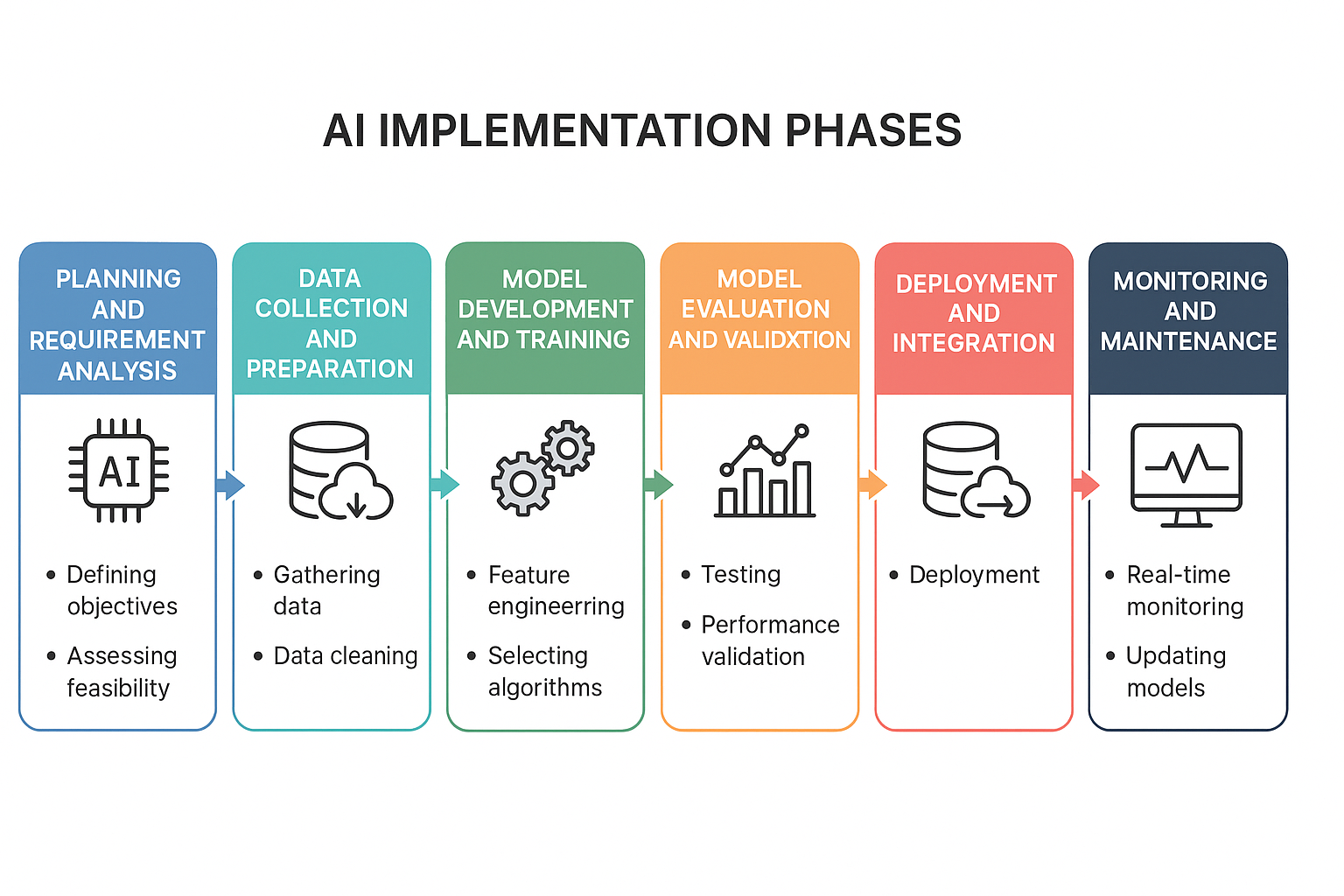
Implementation Strategy: A Step-by-Step Guide
Phase 1: Strategic Planning and Goal Setting
Define Clear Objectives
- Identify specific business challenges AI can address
- Set measurable KPIs and success metrics
- Align AI initiatives with broader business strategy
- Establish budget and timeline expectations
Conduct Feasibility Assessment
- Evaluate current technology infrastructure
- Assess data quality and availability
- Identify skill gaps and training needs
- Analyze potential ROI and risk factors
Phase 2: Data Preparation and Infrastructure
Data Readiness Assessment
- Audit existing data sources and quality
- Implement data cleaning and standardization processes
- Establish data governance and security protocols
- Create centralized data repositories
Technology Infrastructure
- Evaluate cloud computing requirements
- Implement necessary security measures
- Establish API integrations with existing systems
- Plan for scalability and performance optimization
Phase 3: Pilot Implementation
Start Small with High-Impact Use Cases
- Select pilot projects with clear success metrics
- Focus on areas with well-defined processes
- Choose projects with a manageable scope and complexity
- Ensure stakeholder buy-in and support
Partner Selection
- Evaluate AI development companies and platforms
- Consider both technical capabilities and industry expertise
- Assess support and training offerings
- Review case studies and client references
Phase 4: Full-Scale Deployment
System Integration
- Seamlessly integrate AI tools with existing workflows
- Provide comprehensive user training and support
- Establish monitoring and maintenance protocols
- Create feedback loops for continuous improvement
Change Management
- Communicate benefits and address employee concerns
- Provide ongoing training and support
- Monitor adoption rates and user satisfaction
- Adjust implementation based on feedback
Measuring Success and ROI
Key Performance Indicators
Productivity Metrics:
- Time savings per task or process
- Output quality improvements
- Error reduction rates
- Employee satisfaction scores
Financial Metrics:
- Cost reduction percentages
- Revenue growth attribution
- Customer acquisition cost improvements
- Return on investment calculations
Operational Metrics:
- Process efficiency improvements
- Customer satisfaction scores
- Response time reductions
- Accuracy rate improvements
Expected Timeline for Results
Months 1-3: Foundation building and initial implementations
Months 3-6: First measurable improvements in efficiency
Months 6-12: Significant productivity gains and process optimization
Year 1+: Full ROI realization and strategic advantage establishment
Future Trends and Opportunities
Emerging Capabilities for 2025-2026
Multimodal AI: Systems that process text, images, audio, and video simultaneously for more comprehensive analysis and decision-making.
Hyper-Personalization: AI that creates ultra-detailed customer profiles using real-time data from multiple channels to deliver truly individualized experiences.
Real-Time Content Generation: AI systems that create and adapt content instantly based on user engagement and feedback.
Enhanced Human-AI Collaboration: More sophisticated systems that augment human decision-making rather than replace it, creating powerful hybrid workflows.
Investment and Market Projections
The generative AI market is expected to reach $1.3 trillion by 2032, with infrastructure-as-a-service potentially boosting software revenue to $247 billion. This growth represents unprecedented opportunities for businesses that strategically implement AI.
Overcoming Common Implementation Challenges
Technical Challenges and Solutions
Data Quality Issues
- Solution: Implement comprehensive data governance and quality assurance processes
- Investment: 15-20% of the AI budget should focus on data preparation
Integration Complexity
- Solution: Use API-first platforms and microservices architecture
- Strategy: Phase integration gradually with pilot programs
Skill Gaps
- Solution: Invest in employee training and consider partnerships with AI specialists
- Approach: Combine internal training with external consulting support
Strategic Challenges and Mitigation
Change Resistance
- Solution: Focus on employee benefits and provide comprehensive training
- Communication: Emphasize AI as augmentation rather than replacement
ROI Uncertainty
- Solution: Start with measurable, short-term wins before larger investments
- Metrics: Establish clear KPIs and regular progress reviews
Conclusion: The Competitive Imperative
Generative AI has moved beyond the experimental phase to become a business necessity. Companies that successfully implement AI solutions are seeing dramatic improvements in efficiency, customer satisfaction, and competitive positioning. With 92% of Fortune 500 companies already adopting generative AI, the question is not whether to implement AI, but how quickly and effectively you can do so.
The businesses that will thrive in 2025 and beyond are those that view AI not as a cost center, but as a strategic investment in their future. By following the implementation strategies outlined in this guide and focusing on high-impact use cases, organizations can harness the transformative power of generative AI to drive unprecedented growth and innovation.
The AI revolution is not coming here. The only question remaining is whether your business will lead the transformation or struggle to catch up.
This guide provides a foundation for understanding and implementing generative AI in business contexts. For specific implementation support and customized AI strategies, consider consulting with AI development specialists who can tailor solutions to your unique business needs and objectives.